
Wayne Parole and Probation
Parole and probation can both place a person under Utah Department of Corrections Adult Probation and Parole, known as AP&P. They do not begin the same way. Parole follows a prison term and depends on an order from the Utah Board of Pardons and Parole. Probation is imposed by a court and may begin without a state-prison stay. Both are community supervision, so a person may be physically out of a cell while still appearing in the UDC Offender Search.
This distinction matters in Wayne County because a Sevier County Jail release sheet only closes the local jail episode. It does not prove that supervision ended. A probation disposition may follow a short jail term. A parolee may have left USCF while remaining subject to Board conditions. Full discharge means the sentence and supervision have terminated, which is different from being released on parole.
| Point | Parole | Probation |
|---|---|---|
| Starting point | Release from a Utah prison sentence | Court-ordered community sentence |
| Decision maker | Utah Board of Pardons and Parole | Sentencing court |
| Field supervision | UDC Adult Probation and Parole | UDC Adult Probation and Parole for covered cases |
| Key public checks | UDC search plus newest Board decision | UDC search plus the Wayne court docket |
| End point | Board termination or sentence expiration | Court discharge or sentence completion |
Verify Wayne Post-Release Supervision
Begin with a reliable identifier. A UDC offender number is stronger than a name alone. The official state search covers people currently incarcerated by UDC or currently on probation or parole. A matching result must be read by its exact status. “Incarcerated” means state confinement continues. “Parole” or “probation” means the person is in the community under supervision. No result is inconclusive because a fully discharged person may fall outside the search scope.
Use the Board record only for matters within Board jurisdiction. The Search Hearings & Decisions tool accepts an offender number or a name and date range. Read the newest published order, not just the first search result. An original hearing, rehearing, parole date, rescission, warrant, revocation, and termination each describe a different point in the case.
- Search the UDC offender number, or use the exact legal name and confirm the date of birth shown.
- Record whether the result says incarcerated, probation, or parole, along with the listed office or case manager when present.
- Search the Board tool by offender number or exact name and expand the date range if needed.
- Open the latest decision and distinguish a hearing date from an order that sets, changes, or ends parole.
- Check the Wayne court case when probation, a court warrant, or sentence completion is at issue.
- Contact the assigned AP&P office through its public line if the office or current public status remains unclear.
Wayne Supervision Has Two Regions
Wayne County does not have one countywide AP&P office. UDC assigns the west half of the county to Region 4 in Richfield and the east half to Region 6 in Price. That split is tied to supervision coverage. It should not be guessed from where the arrest happened, which court heard the case, or where a person was once housed.
Use the reporting address, agent information, or the office named in current UDC material to determine the right contact. Two people whose cases began in the same Wayne courthouse may report to different regions. Likewise, moving within or outside the county can lead to an approved transfer of supervision. The public search may lag behind a recent office change, so the assigned office is the best source for its own public contact and verification process.
Region 4 Richfield
Adult Probation and Parole
835 E. 300 North #500
Richfield, UT 84701
435-896-2770
Serves west Wayne County
Region 6 Price
Adult Probation and Parole
1365 S. Carbon Avenue
Price, UT 84501
435-636-2800
Serves east Wayne County
Note: Confirm east or west assignment from the approved reporting location rather than the location of the Wayne County arrest.
Wayne Parole Decision Records
The Utah Board of Pardons and Parole controls release decisions for a Utah prison sentence. It can set a parole date, impose special conditions, schedule another review, rescind a date before release, issue a Board warrant, revoke parole, or terminate a sentence. AP&P then handles field supervision. This separation explains why an agent is not the source of the original parole grant and why a Board search does not replace contact with the supervising office.
A tentative original-hearing month is not a release promise. The Board states that the actual hearing day may be set only a few weeks in advance. It also says decisions generally issue within six weeks, while victim information describes a common two-to-six-week period. Search the published record again after the hearing. Then compare the newest order with current UDC status and the actual release event.
The screenshot below comes from the official Board hearing and decision search.
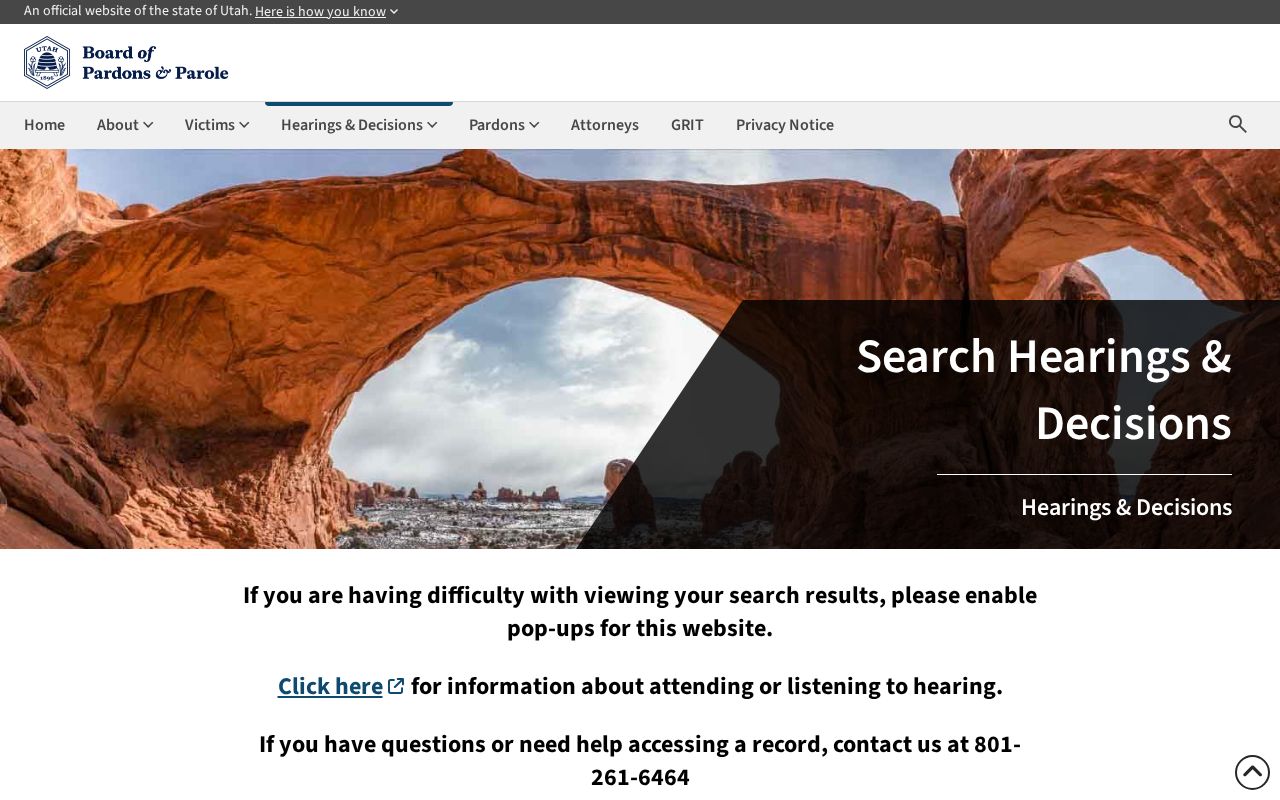
Its person and date filters help locate the governing decision, but the wording inside the latest order controls its meaning.
Wayne Supervision Warrants
A Board warrant means the Board authorized retaking or related process. It does not, by itself, prove that the person is already back in a jail or prison. An absconder is a supervised person alleged to have stopped reporting or otherwise become unavailable to supervision. That label also needs current agency confirmation. Public databases can reflect different update times, and an old decision may have been followed by a later action.
Read the chronological sequence. A warrant may be followed by arrest, a parole-violation hearing, dismissal of allegations, reinstatement, revocation, or a return to custody. If a UDC result shows a prison location, confinement is the current state status. If it still shows parole or probation, ask the assigned office what public status it can confirm. For a separate Wayne court warrant, use the court docket and clerk, not the Board system.
| Record wording | What it supports | What still needs confirmation |
|---|---|---|
| Board warrant | Board-authorized process exists | Whether and where the person was taken into custody |
| Absconder status | Supervision reports loss of contact | Current status and any later action |
| Violation hearing | Alleged parole breach is under review | The final Board decision |
| Revocation order | Parole was revoked as stated | Current placement and later orders |
Wayne Release Conditions
Conditions are binding rules attached to parole or probation. Their exact terms come from the Board order, court order, and approved supervision plan. Public Board decisions can include special parole conditions. A summary in a search result should not be expanded into duties that the order does not state.
Violations also differ. A missed report, an unapproved move, a new case, or failure to meet a special condition may trigger review, but the consequence is not automatic from the allegation alone. AP&P documents field supervision, while the court handles probation decisions and the Board handles parole decisions within their respective authority. The newest order is more reliable than a stale status label.
- Parole
- Conditional community release from a prison sentence under Board authority.
- Probation
- A court-ordered sentence served in the community under stated terms.
- Absconder
- A person alleged to have left supervision or stopped required contact.
- Revocation
- A formal decision ending community release and imposing the stated consequence.
- Discharge
- The end of the sentence or supervision, not merely release from a cell.
Wayne Release Status Alerts
UDC VINE can supplement parole and probation checks, but it does not replace them. Utah lists alerts for prison release, escape and return, death, a parole release date thirty days beforehand, and moves among county jails, state prison sites, and community correctional centers. A VINE alert reports a change from the participating agency. It may not explain the full legal basis or current supervision terms.
Technical issues can make notices late, missing, or inaccurate. UDC expressly warns against sole reliance, and the Board has posted a similar caution. Compare any alert with UDC status and the latest Board decision. For a Wayne local jail episode, a Sevier booking or release record is still needed. For state parole, UDC and BOPP are the controlling sources.
Note: “Out of custody” can coexist with parole or probation because physical release and full legal discharge are separate events.
Ending Wayne County Supervision
Supervision ends through the authority that imposed or controls it. For probation, review the Wayne court register and final order. For parole, read the Board's newest termination, expiration, or other final decision and compare it with UDC status. A person who completed confinement is not necessarily discharged. Sentence expiration or a formal termination record is the stronger end point.
A no-result can follow full discharge, but it can also reflect a spelling error or search-scope limit. Keep the UDC number and court case number when available. A focused UDC records request or court-record request can supply a durable record after a public search changes. For the broader release-record path, the Wayne County released inmate search distinguishes Sevier jail releases, state prison releases, and court dispositions.
Utah expungement can restrict public court access after the required process. If a case is sealed or expunged, do not reconstruct it from an old copy. The correct public result may simply be that no record is available through that channel.