
Wayne Release Dates Explained
A date beside a Wayne County case is not always a projected release date. Utah uses several labels that must remain separate. The Board may publish a tentative month for an Original Hearing. That is only a scheduling estimate. A guideline date is a nonbinding decision aid. A parole or release date in a Board order or UDC record is much closer to the expected custody exit, yet it can still change before the person actually leaves.
Actual release is an event, not a forecast. For a state prisoner, confirm it through final UDC status or a movement and release record, preferably checked against the Board order and VINE event. For a person serving a Wayne local sentence at Sevier County Jail, the Sevier booking and release sheet documents physical departure. A signed court order explains the legal basis, but processing and another agency hold can delay the exit.
- Tentative hearing date
- A preliminary month or year for the first Board hearing, not a release promise.
- Guideline date
- A nonbinding Board aid used with the facts of the individual case.
- Parole or release date
- A date set or reported for release processing that may still change.
- Actual release
- The completed departure shown by the final record of the holding agency.
Wayne Custody Sets the Route
Wayne County has no jail. The Utah Department of Corrections lists zero local jail beds and says people sentenced to jail are transported to Sevier County Jail. That makes Sevier the calculation source for an ordinary county-jail sentence. Wayne Sheriff and the Wayne court may hold the arrest, transport, judgment, bond, and order records, but they do not operate the jail clock.
A Utah prison sentence follows another route. UDC retains legal custody whether the person is at Utah State Correctional Facility, Central Utah Correctional Facility, or an Inmate Placement Program county jail. The public UDC search covers people currently incarcerated or on probation or parole. BOPP controls parole decisions. A person disappearing from a host county roster may have moved back to USCF for release processing rather than entered the community.
| Case or custody | Best date source | Final confirmation |
|---|---|---|
| Pretrial Wayne case | Wayne court docket and current holding agency | Jail release sheet after bond or order is processed |
| County sentence at Sevier | Judgment, jail credit, and Sevier calculation | Sevier booking and release record |
| Utah prison sentence | Latest BOPP order and UDC Release Date and Type | Final UDC release record or corroborated VINE event |
| Federal sentence | BOP Inmate Locator and federal docket | BOP record plus any later custody check |
Find Wayne Inmate Release Dates
Start with the judgment and a stable identifier. A UDC offender number avoids many same-name errors. The UDC Offender Search accepts a UDC number or name. Its public result can show offender number, date of birth, location, housing facility, and a field labeled “Release Date and Type.” Preserve that exact label. Do not silently rename it as a guaranteed projected date.
The Board's separate hearing and decision search shows the order history. Read the newest order because a later rescission, rehearing, contingency, warrant, or termination can replace an earlier date. If only a tentative hearing date appears, there is not yet a Board release date to report.
- Identify the sentencing court, case number, custody system, and inmate or offender number.
- For a state sentence, search UDC and record the exact current status, location, and “Release Date and Type” value.
- Search BOPP by offender number or exact name, then open the newest decision rather than relying on a result heading.
- Read the judgment for every count, the sentence range, credit for time served, and whether terms run together or one after another.
- Check whether the Board actually awarded earned-time credit and whether any release contingency remains unmet.
- Confirm the completed event through the final UDC or Sevier release record.
Note: A no-result in UDC may reflect full discharge or search limits; it does not prove a date or erase prior custody.
Utah Prison Release Framework
Utah felony sentences are generally indeterminate. The court imposes a lawful range, while the Board exercises release authority within it. The Board combines concurrent and consecutive terms to identify total minimum and maximum exposure, schedules an Original Hearing, reviews guidelines and case facts, and then publishes a decision. “Concurrent” means terms run at the same time. “Consecutive” means one follows another.
This structure does not support a blanket claim that every Utah prisoner serves eighty-five percent. No such across-the-board rule was found for Wayne County or Utah prisoners. Offense statutes, mandatory minimums, enhancements, sentence structure, Board decisions, credits, and release conditions can all matter. Utah Code Title 77, Chapter 27 governs Board authority, while the conviction statute supplies the actual range.
Common ranges in Utah Code §76-3-203 include five years to life for a first-degree felony, one to fifteen years for a second-degree felony, and up to five years for a third-degree felony, but the exact offense statute controls. A degree label alone is not enough. Special offenses and enhancements can change the range.
Wayne Earned-Time Release Credits
Utah's earned-time authority is Utah Code §77-27-5.4. The Board's program must provide at least four months of credit for completion of each of up to two approved programs recommended in the case action plan. The Board may award added discretionary credit. This is not a day-for-day county-jail good-time formula, and it is not an automatic percentage cut.
Credit may not apply in listed circumstances. The research identifies limits tied to too little time for credit and transition, life without parole, an order to sentence expiration, no current release date, an unmet release condition, or a Board termination date. UDC notifies the Board after a qualifying program is completed. The Board can forfeit credit when a rescission hearing is needed.
For a Wayne County sentence served at Sevier County Jail, use the court order, lawful jail credit, and Sevier's own calculation. No verified Sevier policy supports importing a good-time formula from another Utah county. Ask for the calculation or release sheet instead of applying the state-prison program to a local term.
Why Wayne Release Dates Change
A future date can move for legal, disciplinary, program, or administrative reasons. The newest record should be checked close to the expected event. A court can correct sentence credit. The Board can schedule a rehearing or rescind a grant before physical release. Another agency can lodge a detainer, which is a request or hold affecting where the person goes next.
| Factor | Possible effect | Record to check |
|---|---|---|
| Credit correction | Changes the sentence calculation | Judgment, amended order, and agency calculation |
| Concurrent or consecutive terms | Changes total minimum and maximum exposure | Judgment and BOPP calculation |
| Earned-time award or forfeiture | Moves a Board-controlled date when statute applies | UDC completion record and Board decision |
| New detainer or case | Can change destination or block community release | Holding agency, court, and receiving agency record |
| Board rehearing or rescission | Replaces or withdraws an earlier parole date | Newest BOPP order |
| Address or release contingency | Can delay an approved parole date | Board decision and AP&P confirmation |
| Administrative correction | Fixes data or sentence computation | Corrected UDC or jail record |
Note: A transfer changes physical placement. It is not community release unless the final record states that custody ended.
Wayne State Releases Return to USCF
UDC publishes a distinctive release route for state prisoners in county jails. Its Release Day FAQ says almost everyone housed in a county jail is returned to Utah State Correctional Facility before release, with rare exceptions shared with family. Releases and paroles are processed on Tuesdays and are generally completed through the USCF Visiting building. This policy applies to UDC prisoners, not ordinary Sevier county inmates.
The practical result is easy to misread. A Wayne defendant in UDC custody may disappear from a contract jail list before the parole date because transport to USCF has begun. That movement does not confirm freedom. Follow the host-jail movement record to UDC status, then the latest Board order, and finally the actual UDC release or VINE event. That chain is more reliable than a roster disappearance.
The route also explains why UDC, not the host jail, owns the state sentence calculation. Physical housing can change several times while the UDC number and Board case remain stable.
Release timing can also differ from sentence termination. A parole date ends the prison portion if UDC completes the release, but AP&P supervision can continue afterward. A termination or expiration date answers when the state sentence ends. Keeping both dates avoids reporting parole as full discharge. If the public search later drops the person because current supervision ended, the earlier Board order, judgment, and focused UDC response become the durable record.
Wayne Board Date Search
The official Utah Board search provides name, offender-number, and date-range access to hearings and decisions.
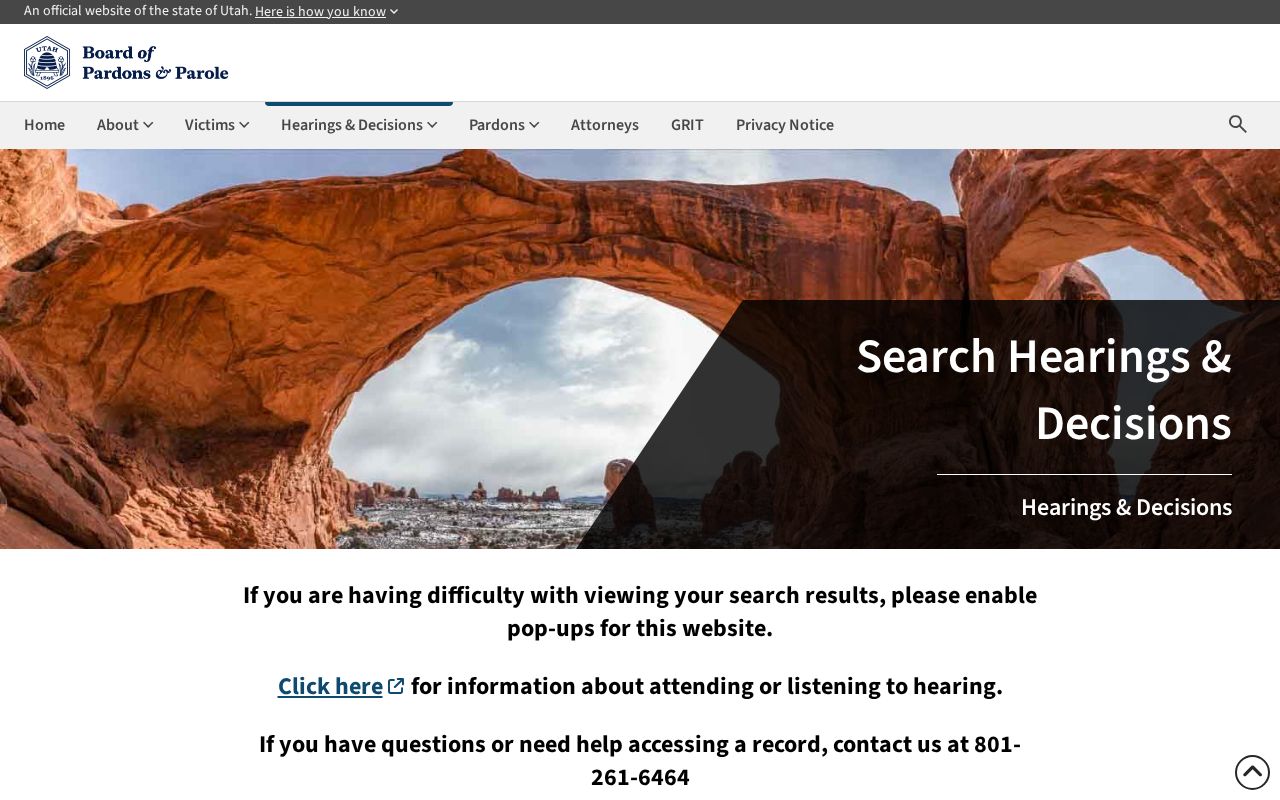
The result must be opened and read in sequence. A hearing listing is not the same as a parole order, and an older order may have been changed.
Confirm Wayne Actual Release
For a state prisoner, compare UDC's current “Release Date and Type” with the newest Board decision. Then verify the physical event through a final UDC record. VINE can send a release or transfer alert, but UDC warns against depending on it alone. The Wayne County VINELink release check covers the notification steps.
For a local sentence, request Sevier's booking and release sheet. Pair it with the Wayne court order if the legal reason matters. If Sevier records a transfer, identify the destination. UDC, another county jail, ICE, or the U.S. Marshals Service each requires a different next check.
Use a focused GRAMA request when the public searches cannot resolve the date. Ask for an existing movement, calculation, release, or discharge record, supply the case or offender number, and request the public portions. Do not ask the custodian to invent a forecast. A final agency record answers whether the planned date became an actual release.
Save the source date and exact label with any result. Dynamic records can change after a Board action, sentence correction, or move. A dated copy makes later differences easier to reconcile with UDC, Sevier, or the court clerk.